Imaging techniques are vital for accurate diagnosis and effective treatment planning. Among the most common techniques are computed tomography (CT) scans and magnetic resonance imaging (MRI) scans. While both imaging methods serve essential roles, they operate on different principles and are preferred in different clinical scenarios. You may need an MRI after a CT if the results are inconclusive. Similarly, if more investigation is needed after a CT, an MRI may be necessary.
So why would a doctor choose an MRI over a CT, or vice versa? Let’s explore the differences between CT scans and MRI scans, including their applications, advantages, and why your healthcare provider might choose one over the other.
Similarities and differences between CT scans and MRI scans
MRI and CT scans are both essential imaging techniques used in modern medicine to help diagnose and assess various medical conditions. Both methods allow healthcare providers to visualize internal structures of the body, aiding in treatment planning and monitoring disease progression. Additionally, both MRI and CT scans can be ordered by licensed medical practitioners and are crucial tools in emergency and routine healthcare settings.
Now, onto the differences — CT scan uses advanced X-ray technology to quickly create detailed, cross-sectional images of your bones and blood vessels. An MRI uses magnets and radio waves to create detailed images of soft tissues, nerves, and organs.
| Features | CT Scans | MRI Scans |
|---|---|---|
| Technology | X-ray technology and computer processing | Powerful magnet and radio waves |
| Best Used For | Bones, lungs, emergencies, trauma, and blood vessels | Soft tissues, nerves, ligaments, tendons, and the brain |
| Speed | 5-10 minutes on average | 30-60 minutes on average |
| Radiation | Uses a small amount of ionizing radiation | No radiation is used |
| Limitations | Safe for most patients; less sensitive to movement | Unsafe if you have an incompatible metal implant; can trigger claustrophobia |
| Getting Results | Results are delivered directly to you and your provider | Results are delivered directly to you and your provider |
Why doctors recommend MRI scans
Doctors recommend MRI scans because they provide detailed, high-resolution images that aid in diagnosing a wide range of conditions. This non-invasive imaging technique is particularly useful for assessing soft tissues, identifying injuries, and monitoring diseases, allowing for more accurate and effective treatment plans.
MRI scans provide high-resolution images of various bodily structures, including:
- Blood vessels
- Cartilage
- Joints
- Ligaments
- Muscles
- Nerve roots
- Organs such as the brain, liver, kidneys, pancreas, and abdominal organs
- Soft tissues
- Spinal cord and spinal discs
- Tendons
Conditions detected with an MRI
- Neurological disorders. MRI is effective in diagnosing brain tumors, stroke, and multiple sclerosis. A neurologist might use a brain MRI to look for small strokes or tumors.
- Cancer. Prostate MRI and breast MRI scans are used to help get a closer look at suspected cancers and reveal the extent of the disease.
- Joint and soft tissue injuries. MRI assesses ligament, tendon, and cartilage damage, as well as musculoskeletal injuries or disorders. An orthopedist might order an MRI to check for a torn knee ligament.
- Congenital heart diseases. A chest MRI aids in detecting vascular diseases, congenital heart issues, and unexplained chest pain.
- Spinal conditions. Because it visualizes the spinal cord effectively, an MRI is also the top choice for diagnosing chronic back pain and herniated discs.
The MRI experience
MRI scans typically take 30-60 minutes, requiring patients to remain still for that long. Additionally, the closed environment of an MRI machine may pose challenges for claustrophobic patients.
At South Jersey Radiology Associates (SJRA), wide-bore MRI options are designed with a larger opening, offering up to 20% more head space than traditional MRI scanners and accommodating patients up to 550 lbs. Additionally, MRI machines at SJRA are equipped with fast scan technology that can reduce average scan times by up to 48%.
Unlike CT scans, MRIs do not involve ionizing radiation, making them a safer option in certain scenarios, particularly for repeated studies or for use in children. However, those with metal implants, such as pacemakers or certain types of surgical hardware, may be at risk when undergoing an MRI, as the magnetic field can interfere with these devices or pose safety concerns.
View our available appointments at a location near you today
When CT scans are preferred
A CT scan is an advanced tool for checking dense bone structures and fast-moving organs. CT scans offer rapid decision-making capabilities, providing immediate assessments in trauma cases that are critical for guiding treatment decisions. This efficiency and comfort make CT scans an invaluable tool in emergency medical settings.
These scans are often the go-to imaging choice for several reasons:
- Speed. CT scans typically take just 5-10 minutes to complete, offering rapid results.
- Clarity. They provide detailed images of bones and soft tissues.
- Comfort. Unlike MRI machines, CT scans are generally more accommodating for those with claustrophobia.
- Accommodation. CT machines can easily handle metal implants because they do not use strong magnetic fields.
Conditions detected with a CT scan
Doctors frequently use CT scans to quickly spot bone fractures, internal bleeding, blood clots, kidney stones, and lung issues like pneumonia or COPD.
CT scans are also used to detect:
- Traumatic injuries. CT scans quickly identify fractures and assess damage to internal organs. It also helps detect internal bleeding, providing crucial information for immediate medical intervention.
- Cancer. In cancer detection, CT scans are invaluable for detecting tumors in various organs. Low-dose lung CT scans are used to detect lung cancer, while pelvic CT scans are used to help detect liver, testicular, and kidney cancer. These scans can also help detect pancreatic cancer, brain tumors, and other rare cancers.
- Infectious diseases. CT scans can be particularly helpful in tracking treatment progress for infections such as pneumonia, especially when the response to treatment is unusually slow. CT scans can help doctors determine the extent and severity of the infection.
- Heart and vascular issues. CT scans assist in diagnosing coronary artery disease and identifying arterial blockages. Cardiac CT angiography (CTA) provides detailed images of the coronary arteries. Additionally, CT calcium scoring assesses calcified plaque in the arteries, helping evaluate heart health and function.
The CT experience
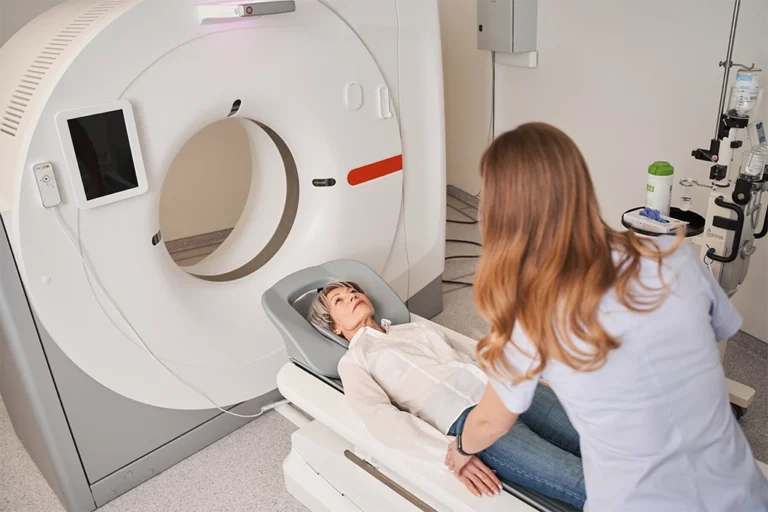
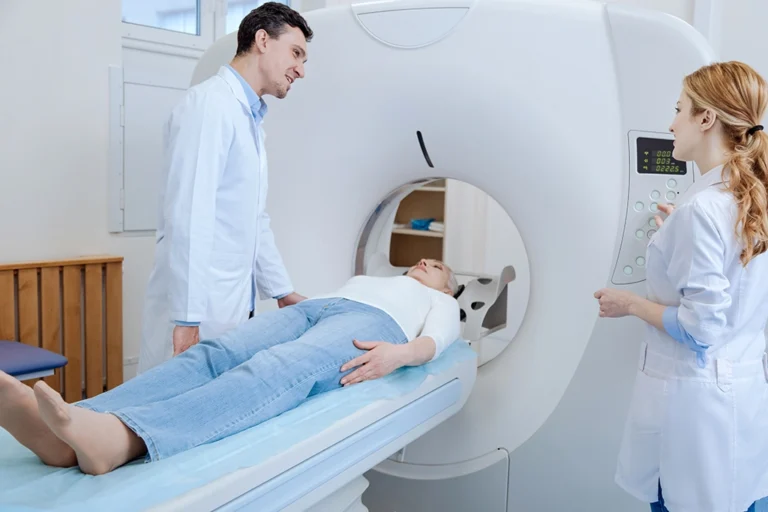
CT scans are typically quick, often taking only 5 to 10 minutes. Patients may be asked to lie still on a table that moves through a large, donut-shaped machine while X-ray images are captured.
Why would a doctor order both CT and MRI?
Typically, an MRI is ordered after a CT if results are inconclusive or to check for additional abnormalities if there is an issue preventing a deeper look.
Head injuries and acute care
If you suffer a severe head or traumatic brain injury, an ER doctor will do a head CT scan first to quickly rule out a skull fracture or a major bleed. Once you are safe and stable, they might order an MRI as a follow-up to check for microscopic tissue damage that the initial CT couldn’t see.
Cancer impacts and tracking
Both CT and MRI scans can assess the size and location of a tumor and provide information about its effects on surrounding tissues, allowing doctors to monitor changes over time and adjust treatment plans accordingly.
Preoperative planning
Surgeons may order both scans to obtain a comprehensive view of the anatomy before a procedure, enabling them to visualize critical structures and minimize potential complications during surgery.
Assessment of complex conditions
For conditions such as spinal injuries or rare diseases, using both imaging techniques can lead to a more accurate diagnosis, as complementary information helps understand the full extent and nature of the abnormality.
Do doctors prefer CT scans vs. MRI scans?
There is no single “best” test. The right scan is simply the one that fits your specific medical needs. If you need a quick look at a bone fracture or a chest issue, CT wins. If you need a deep dive into your spinal cord or joint injuries, MRI is the clear answer.
Cost is also an important factor. Both scans can be expensive at a hospital, but choosing an outpatient imaging center like SJRA can save you up to 60% compared to hospital-based imaging.
In summary: CT scans vs. MRI scans
CT scans and MRI scans are essential diagnostic tools that help healthcare providers visualize internal body structures, but they are used in different clinical scenarios. Understanding when each imaging technique is preferred can lead to quicker diagnoses and more effective treatment plans.
- CT scans use X-ray technology to create detailed images of bones and other dense structures — making them ideal for emergencies and trauma — while MRI scans use magnets and radio waves to produce high-resolution images of soft tissues, nerves, and organs.
- MRI scans do not involve ionizing radiation, making them safer for repeated use and for children, whereas CT scans are faster and may be more comfortable for patients with claustrophobia.
- MRIs are best for diagnosing neurological disorders, joint injuries, and soft tissue conditions, while CT scans are preferred for traumatic injuries, internal bleeding, and comprehensive assessments of the chest and abdomen.
At SJRA, our goal is to provide you and your healthcare provider with the most informative results possible, and we make it easy for you to schedule an appointment. With numerous locations across South Jersey, you’ll find us conveniently near major highways and key bridges. We’ll ensure the entire scheduling process is as effortless as possible for you. Above all, we are here to help you.
Ready to schedule your diagnostic imaging appointment? Call us at 1 (888) 909-7572 or schedule an appointment online today.
Frequently Asked Questions
Both scans are incredibly safe and widely used in modern medicine. Because an MRI machine doesn’t use any ionizing radiation, it is often considered the safer choice for people who need frequent, long-term monitoring, like cancer patients tracking their treatment.
However, an MRI can be dangerous if you have an incompatible metal implant (like a pacemaker) because of the machine’s strong magnets. In those cases, a CT scan is the healthier, necessary alternative.
CT scanners are shaped like a large ring rather than a deep, enclosed tunnel. Because they are more open and significantly faster than MRIs, they are much easier for claustrophobic patients to tolerate.
Determining which imaging modality is “best” varies based on patient needs and clinical scenarios. Neither system is unequivocally superior, and each has its unique strengths.
Primary care physicians, neurologists, oncologists, orthopedists, and emergency room doctors can all order these scans depending on your specific medical needs.
Because CT scans are used in urgent scenarios, the images are processed rapidly, and your doctor may receive results very shortly after your scan. MRI results generally take a few days, and your doctor will reach out to schedule a consultation.
At South Jersey Radiology Associates, you can schedule your MRI scan at any of the following offices:
1. Marlton (Greentree) Office – Marlton, NJ
2. Medford Office – Medford, NJ
3. Moorestown Office – Moorestown, NJ
4. Mount Laurel Office – Mount Laurel, NJ
5. Route 73 (Voorhees) Office – Voorhees Township, NJ
6. Sewell (Washington Twp) Office – Sewell, NJ
7. Turnersville Office – Turnersville, NJ
8.Voorhees (Carnie Blvd) Office – Voorhees Township, NJ
9. West Deptford Office – West Deptford, NJ
10. Willingboro Office – Willingboro, NJ
At South Jersey Radiology Associates, you can schedule your CT scan at any of the following offices:
1. Haddonfield Office – Haddonfield, NJ
2. Marlton (Greentree) Office – Marlton, NJ
3. Medford Office – Medford, NJ
4. Mount Laurel Office – Mount Laurel, NJ
5. Sewell (Washington Twp) Office – Sewell, NJ
6. Moorestown Office – Moorestown, NJ
7. Turnersville Office – Turnersville, NJ
8. Voorhees (Carnie Blvd) Office – Voorhees Township, NJ
9. Route 73 (Voorhees) Office – Voorhees Township, NJ
10. West Deptford Office – West Deptford, NJ
11. Willingboro Office – Willingboro, NJ