







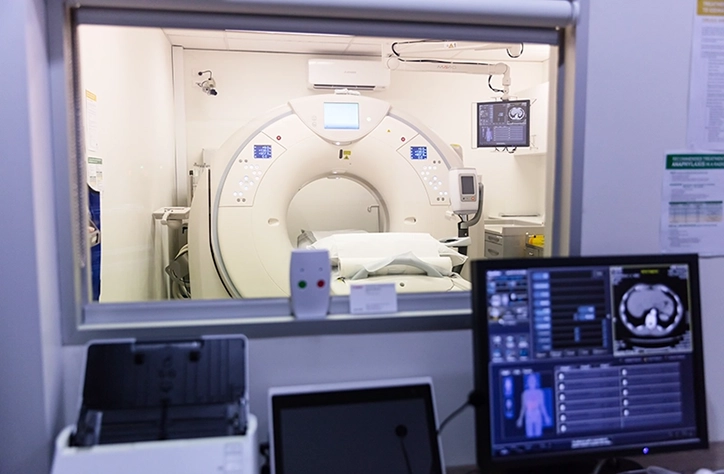

A low-dose CT lung screening, also known as a lung cancer screening, is an imaging study performed to assess lung tissue for early signs in high risk individuals before symptoms are present.
A low-dose CT lung cancer screening may be recommended by your doctor if you are identified as an individual with elevated screening risk.
Yes, an imaging referral is required for lung cancer screening.
While all three exams use X-ray technology, each are recommended in different scenarios.
A chest X-ray creates one to three flat images of the chest and is often used quickly evaluate acute symptoms such as cough, fever, or chest pain. However, it may not identify very small abnormalities, crucial for detecting early stage-lung cancer.
A low-dose CT (LDCT) scan captures hundreds of detailed cross sectional images of the lungs from multiple angles. These images allow radiologists to examine the lungs layer by layer, helping detect slight changes over time. Low-dose CT lung screening is specifically designed for cancer screenings where repetition over time may be required, and uses significantly less radiation than a diagnostic chest CT.
A diagnostic chest CT provides a similar level of detail, but typically uses a higher radiation dose and is often recommended by a doctor to evaluate symptoms or investigate an abnormal finding. If additional imaging is needed after a screening exam, a diagnostic chest CT or PET/CT may be recommended.
Men and women qualify for lung cancer screening if they meet all of the following criteria below:
• Age 50 – 77 years old
• Current smoker or have quit within the last 15 years
• No signs or symptoms of lung cancer
• Tobacco smoking history of at least 20-packs years (20 pack years defined as 1-pack per day for 20 years)
Yes, current smokers can get screened for lung cancer. In fact, current smokers are among the people most likely to benefit from lung cancer screening.
It’s important to know screening is not a substitute for quitting smoking. Quitting smoking remains the most effective way to deduce your risk of lung cancer and other smoking-related diseases.
For eligible patients, low-dose CT (LDCT) screening is the most effective screening approach for early detection of lung cancer.
Preparing for a low-dose CT lung cancer screening is simple. No special preparation is typically required, and you can usually eat, drink, and take medications as directed by your doctor.
The screening is painless, non-invasive, and does not require needles, injections, or contrast material. You’ll lie comfortably on a padded table that moves through the CT scanner while the the system captures images of your lungs.
During the screening, you may be asked to hold your breath for a few seconds to help produce the clearest possible images.
Most patients spend about 20 – 30 minutes at one of our centers, while the screening itself takes less than 5 minutes.
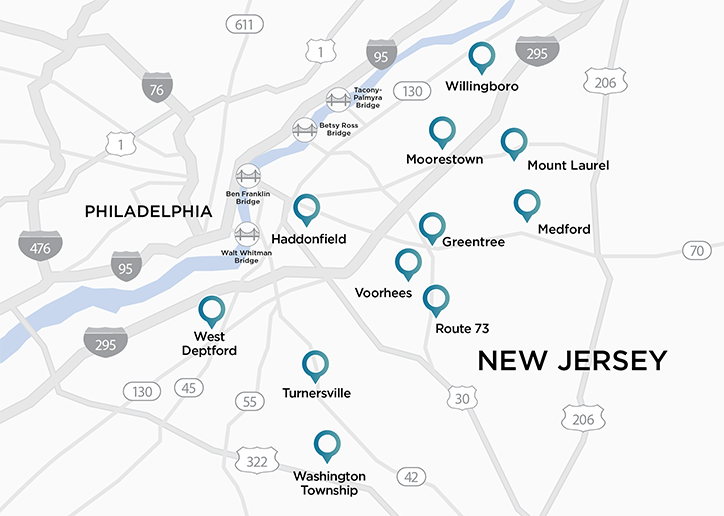
We offer evening and weekend hours with select locations offering same-day and next-day appointments for lung cancer screening at:
• Haddonfield
• Marlton (Greentree)
• Mount Laurel
• Medford
• Moorestown
• Route 73 (Voorhees)
• Turnersville
• Voorhees (Carnie Blvd)
• Sewell (Washington Twp)
• West Deptford
• Willingboro
Lung-RADS® is a standardized interpretation framework developed by the American College of Radiology (ACR) to assign patients with a specific category based on your risk to help plan next steps in care. The categories range from 1 (negative) – 4X (highly suspicious).
Typically, lung cancer screening is recommended to be repeated annually for eligible patients. It is important to understand the interval and/or follow up study may change based on the findings of your most recent screening.
Most insurance providers cover annual low-dose CT lung cancer screening with no out-of-pocket costs for those eligible.
South Jersey Radiology is in-network with 99% of insurance providers. Please contact your insurance provider to inquire about SJRA’s in-network status. Some insurance companies may try to direct you to their preferred radiology center. As the patient, you have the right to choose if you would like your study performed at South Jersey Radiology.
If a lung nodule is identified during your lung cancer screening, the measurements and specifications of each nodule will be denoted on your report. Your doctor will follow up with you for next steps based on the findings.
95% of lung nodules are typically benign and may be scarring from past conditions. It is important to follow up with your doctor to determine if additional imaging or testing is needed to confirm the presence or absence of lung cancer.
A pack-year history is calculated by multiplying the average number of packs you smoked per day by the number of years you smoked.
• Example #1 – Smoked 1 pack per day for 20 years = 20-pack years
• Example #2 – Smoked 2 pack per day for 10 years = 20-pack years
• Example #3 – Smoked half a pack per day for 40 years = 20-pack years
While smoking is the primary risk factor for lung cancer, a growing percentage of cases occur in people who have never smoked, have already quit, or who have been exposed to other risk factors, such as environmental toxins.
Radon, asbestos, and secondhand smoke are all categorized as an environmental toxins, but it is important to discuss you specific situation with your doctor to determine if lung cancer screening is right for you.
Lung cancer screening may detect other lung diseases like COPD or emphysema incidentally, but it is not the preferred imaging approach to check for these conditions. A standard chest CT is typically recommended if these conditions are suspected.